
The conversations that come into the Brake & Clutch Warehouse parts counter at Thomastown follow that pattern. A workshop calls, asks about a clutch kit for a specific platform, mentions in passing that the customer reported slip on hills. Before that order goes through, the slip needs to be confirmed.
The cost gap between a clutch kit job and a hydraulic repair is the kind that loses the customer twice: once when the bill is higher than it needed to be, again when the original symptom comes back because the actual fault was a CSC, a contaminated disc, or a DMF that's been masking itself as clutch wear.
Why confirmation matters before you quote a kit
Quoting a clutch kit on a fault that wasn't the clutch is the most expensive mistake in the bellhousing job. The labour bill is the same either way. The parts bill is significantly higher on a full kit than on a hydraulic repair. The customer relationship takes the full brunt of the difference when the comeback walks in.
Three patterns to watch for:
- A “new clutch” that doesn't fix the complaint. The slip is still there because the slip wasn't from the friction surface in the first place. Usually a rear main leak that contaminated the new disc straight away, or a CSC that's intermittently bleeding pressure off, or a DMF that no longer damps cleanly.
- A glazed disc on a still-serviceable clutch. The friction surface is hardened from a bedding-in problem on the previous fit. Replacing the disc fixes the symptom; replacing the whole kit fixes it too, just more expensively than it needed to.
- A hydraulic fault presenting as clutch wear. CSC seal degradation is the most common. The pedal feels different, the engagement point drifts, but the customer reports it as slip because that's the symptom they noticed.
The confirmation step takes 15 to 20 minutes. The wrong quote costs a day's labour plus a kit's worth of parts plus the customer.
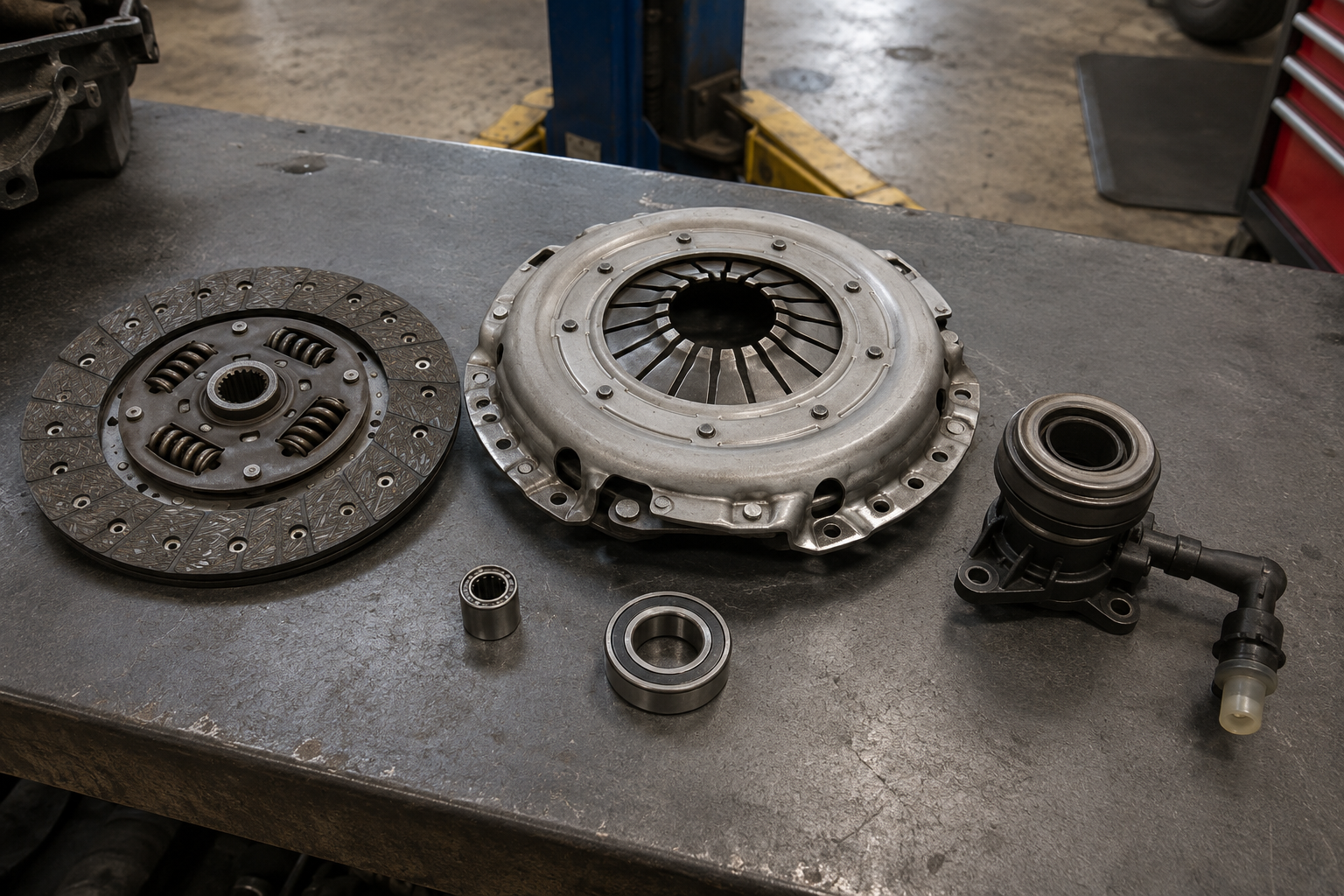
Slip complaint triage: from symptom to confirmation test
The four ways a slip complaint commonly walks in, and the test that confirms or rules each one out:
| Customer complaint | Likely fault | Confirmation test |
|---|---|---|
| Revs rise without speed under load (worse on hills, worse in higher gears) | True clutch slip | Stall test or hill-load test |
| High bite-point, hard pedal, or pedal sinks under load | Hydraulic: CSC, master cylinder, fluid contamination | Pedal travel, fluid check, hydraulic pressure |
| Judder on take-off, especially when cold | DMF, disc damping, flywheel surface, oil contamination | DMF rock test, inspection at removal |
| Won't disengage cleanly, gear selection is difficult | Cable, hydraulic master, pilot bearing, CSC | Bleed, pedal travel measurement, inspection at removal |
This article walks through the slip row. The other three rows have their own diagnostic paths, but if a slip complaint walks in and the symptom fits one of the other rows, the kit isn't the answer.
How to confirm a slipping clutch
Three tests, in order. Two on the car, one at removal. Most slip complaints can be confirmed or ruled out from the on-vehicle tests alone.
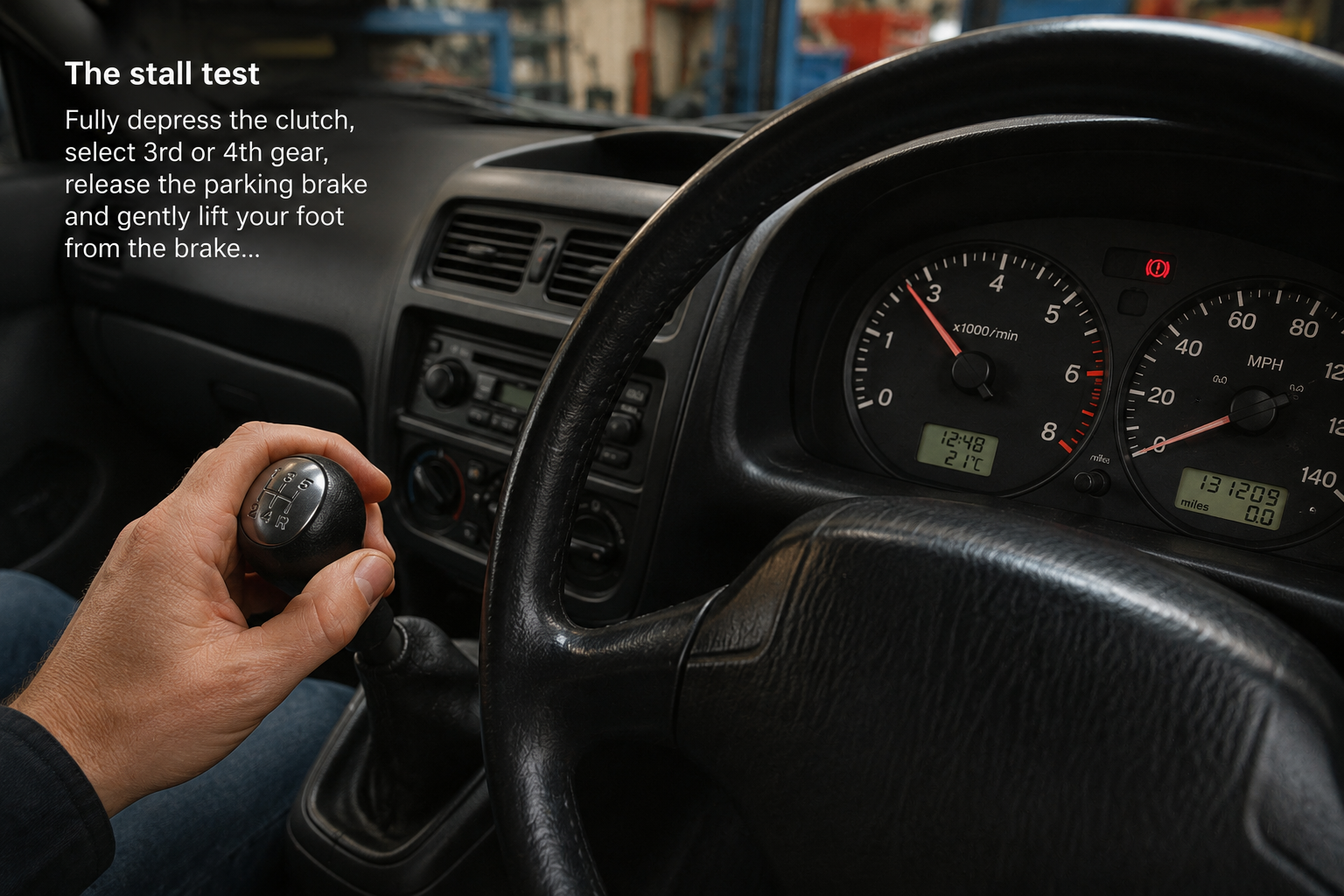
The stall test
Park on flat. Handbrake firm. Engine running, clutch in, third gear selected. Gradual release of the clutch pedal with light throttle, watching the tacho.
A serviceable clutch will load the engine and stall it within a couple of seconds. A slipping clutch will let the revs rise without the engine stalling, because the friction surface isn't transmitting enough torque to load the crank against the brake.
The test takes 15 seconds and gives a clean answer on a healthy drivetrain.
Safety note on DMF vehicles: the stall test stresses the arc springs inside a dual mass flywheel. On a marginal DMF, the damping mechanism can be damaged by the load, particularly on diesel platforms where the torque pulse is already high. If the vehicle is a known DMF platform (most modern European diesels, current-generation HiLux and Ranger, common turbo-diesel utes), use the hill-load test instead, or do the stall test very briefly and only once. Don't repeat it on a vehicle you suspect already has a tired DMF.
The hill-load test
Recreate the customer's complaint. If they reported slip on the climb up Plenty Road, drive the climb up Plenty Road. Third or fourth gear, accelerate from low revs into mid-load.
A confirmed slip shows up as engine revs rising without matched road speed. The tacho leads the speedo. The complaint becomes reproducible on demand, which is what you need before quoting.
This is the safer test for DMF vehicles because the load is graduated and the operator can back off the moment the symptom appears. It's also closer to the customer's actual driving condition, which matters when the complaint is intermittent or fades in the workshop.
Inspection at removal
If the on-vehicle tests confirm the slip, the next step is removal and inspection. This is where the diagnosis closes. Check the following:
- Disc thickness measured against manufacturer spec, not against the old one. A disc that looks worn might still be within tolerance.
- Friction surface condition. Glazed, worn evenly, or contaminated. Each tells a different story about why the slip happened.
- Oil contamination from a rear main seal or input shaft seal. A wet disc is rarely a clutch fault; it's a seal fault that produced a clutch symptom.
- Flywheel surface check. Heat checking, scoring, blue discolouration. A scored flywheel will glaze the next disc the same way it glazed this one.
- CSC condition on hydraulic platforms. Fluid weep at the bellhousing, seal damage, sticky operation.
The inspection step is where the “but it could have been the hydraulics” question gets answered definitively. If everything in the friction stack is within spec and the CSC is the only worn part, the kit isn't what the car needs.
What gets misdiagnosed as a slipping clutch
Five common faults that present as slip but aren't:
- Rear main seal leak contaminating the disc. Engine oil migrates onto the friction surface, drops the coefficient of friction, mimics a worn clutch under load. The disc is visibly wet on inspection. The rear main is the fix, with a new disc as the consequence, not the cause.
- Hydraulic fluid contamination. Old fluid, water-contaminated fluid, or wrong-spec fluid in the clutch hydraulic system. On shared-reservoir platforms (common across Honda, Toyota, VW, Hyundai, and many Mazda manuals), brake fluid issues affect the clutch the same way they affect the brakes. Check fluid condition before quoting parts.
- CSC partial failure. The seal leaks past intermittently. Pedal travel shifts under thermal load. The clutch feels like it slips because hydraulic pressure isn't fully releasing the pressure plate. The friction disc may have plenty of life left.
- Glazed disc from a bad bed-in. The previous clutch was fitted but not bedded in correctly, or the flywheel wasn't machined when it should have been. The disc has gone hard and shiny. Replacing just the disc and machining the flywheel may be the right scope.
- DMF failure. The damping springs in the secondary mass have failed. The clutch feels like it's slipping under load because the DMF isn't transmitting torque cleanly. The judder on take-off is the giveaway, but on early-stage DMF failure the slip-feel can appear before the judder does.
The pattern across all five: each can produce a slip-like complaint. None are fixed by a clutch kit alone. Four of them get worse with a clutch kit because the underlying fault stays in the car after the new kit is in.
How to explain the inspection step to the customer
The customer has heard “you need a new clutch” already. Sometimes they've heard it from another shop. Sometimes they've heard it from themselves on the drive in. The job is to explain why the inspection step is worth the wait.
Three things to put on the table.
When to call the parts counter before the customer commits
Brake & Clutch Warehouse stocks clutch kits for the common Australian-market manual platforms (HiLux, Ranger, Triton, BT-50, Camry, Corolla manual, Mazda 3 manual, Golf, Polo, and most performance and 4WD platforms). The hydraulics range covers CSCs, clutch master cylinders, slave cylinders, and complete hydraulic kits, which is where most misdiagnosed slips need to land. Hydraulic-only fixes go out the door same day to most northern Melbourne workshops.
The parts counter is also a sense-check line. If the diagnosis sits between a kit and a hydraulic repair, or the customer is pushing for the cheaper option and the tests haven't ruled it out yet, call before you commit. Phone the counter on 03 9465 9344, or check kit availability on the in-stock parts page before the gearbox comes out.