
Get that call wrong and the comeback can be expensive. A worn dual mass flywheel can create rattle, judder, vibration, poor engagement, and clutch life problems. A flywheel that should have been replaced can make a new clutch look like the failed part. A single mass conversion can solve one problem while creating another if the customer was not warned about noise or driveline feel.
The right answer is not always "replace it" and not always "convert it". The right answer depends on the measured wear, the surface condition, the vehicle use, and what the customer expects from the car after the job.
What does a dual mass flywheel do?
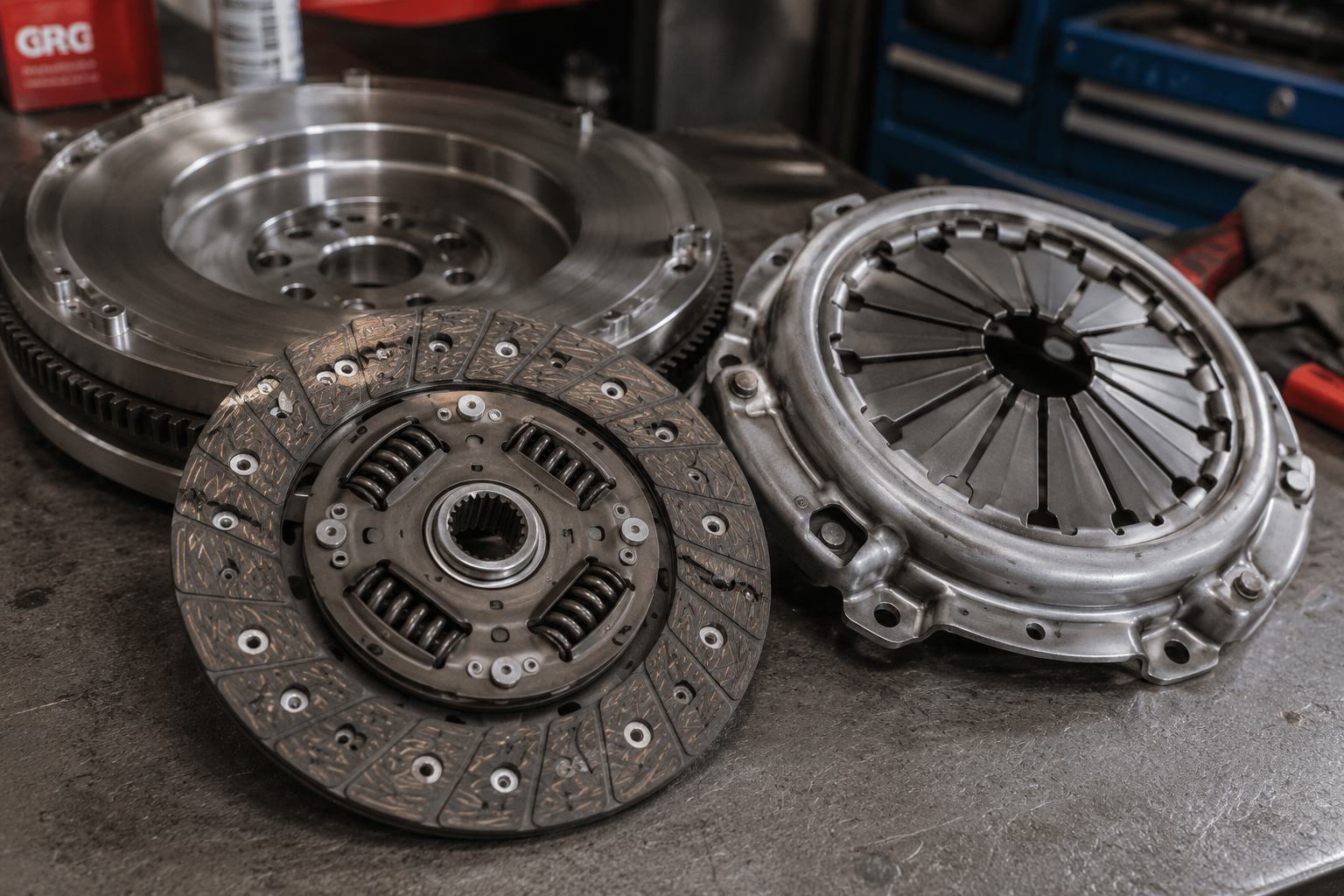
A dual mass flywheel, or DMF, sits between the engine and clutch. Unlike a solid flywheel, it has two main rotating sections. The primary mass is attached to the crankshaft. The secondary mass carries the clutch assembly. Between them are damping components designed to absorb torsional vibration before it reaches the gearbox.
That matters on modern diesel, turbo-petrol, 4WD, European, and high-torque manual vehicles. Engine torque pulses are not smooth. The DMF takes the sharpness out of those pulses so the gearbox is quieter, the clutch engages more smoothly, and low-speed driveline harshness is reduced.
A failed DMF does the opposite. It can let vibration, rattle, and uneven load transfer through the driveline. That is why the flywheel decision should not be treated as an afterthought once the clutch is already out.
What should be checked before reusing a DMF?
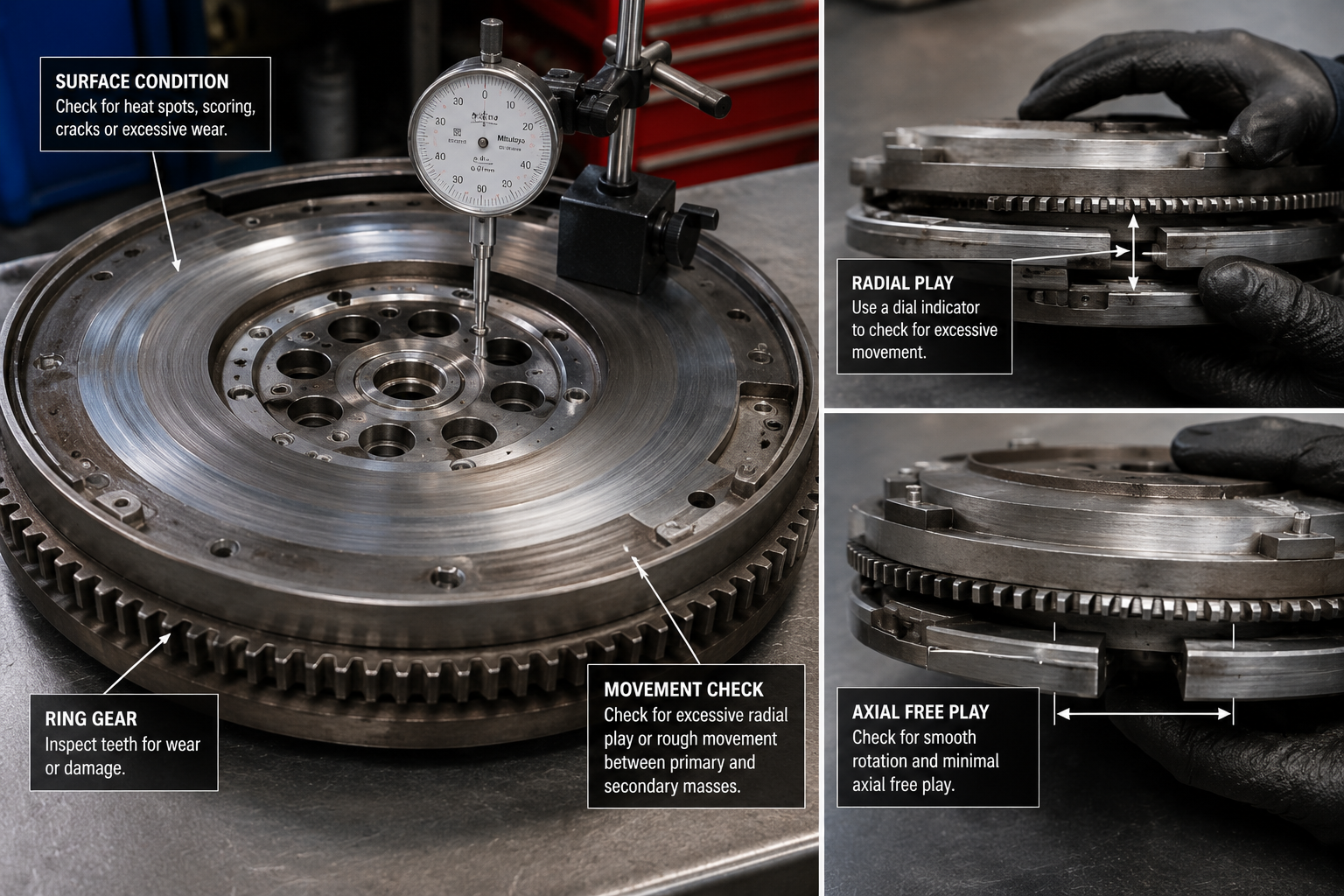
Before a dual mass flywheel is reused, it needs more than a quick glance at the friction face. The surface condition matters, but it is only one part of the decision.
| Check | What it tells you | Decision risk |
|---|---|---|
| Rotational free play | Wear in the internal damping mechanism | Reuse only if within specification |
| Rock or tilt | Bearing wear or excessive movement between masses | Replace if outside tolerance |
| Heat marks | Evidence of clutch slip or thermal stress | Inspect closely before reuse |
| Grease leakage | Possible internal failure or lubricant loss | Heavy leakage points to replacement |
| Surface scoring | Damage at the clutch contact face | Depends on depth, design, and spec |
| Rattle or knock | Internal damper, bearing, or spring issue | Replace or investigate further |
| Starter ring condition | Damage that can affect starting or sensor operation | Replace if damaged or loose |
| Vehicle use | Towing, fleet use, tuning, or heavy loads | Lower tolerance for borderline reuse |
Do not use a universal free-play number. DMF specifications vary by manufacturer and model. Some units can show movement that is normal for that design. Others are already outside spec with less obvious movement. Check the vehicle procedure, supplier guidance, or part-specific data before giving the customer a reuse verdict.
Can a dual mass flywheel be machined?
This is where many clutch jobs get oversimplified.
A dual mass flywheel is not just a thick steel disc that can be skimmed like a conventional solid flywheel. It has internal damping parts, grease, bearings or bushings, and a secondary mass that moves against the primary mass. That makes machining a DMF a different decision from machining a solid flywheel.
Some flywheel surfaces may be serviceable in limited conditions, depending on the design and the supplier guidance. Brake & Clutch Warehouse publicly states that it machines flywheels, including single-mass and dual-mass units where applicable, and that machining is carried out to manufacturer specifications and safety limits.
That phrase "where applicable" is the key.
A DMF should not be promised as machinable until the unit has been inspected and the correct procedure has been checked. If the unit is outside spec, has internal movement beyond tolerance, has heavy grease leakage, or the manufacturer does not allow resurfacing, machining is not the safe answer.
A useful quoting rule is:
- solid flywheel: assess thickness, step, runout, heat damage, and surface condition
- dual mass flywheel: assess all of the above, plus internal movement, damping, leakage, noise, and manufacturer guidance
If the machining path is not clear, price the job around replacement or quote the flywheel decision after teardown.
When is dual mass flywheel replacement the right call?
Replacement is usually the safer call when the evidence points to internal wear or surface damage that cannot be corrected within spec.
- Free play or rock outside specification. Movement between the two masses is expected, but it must sit within the correct range for that unit. Excessive rotational movement, tilt, or knocking between the masses is not a friction-surface problem. It is a DMF problem.
- Heat damage from clutch slip. A slipping clutch can mark the friction face, overheat the surface, and load the DMF beyond its normal operating range. Blueing, hot spots, cracking, or a burnt clutch smell should slow the quote down.
- Grease leakage. Light traces may be normal on some designs, but heavy leakage suggests the internal damping system has lost lubrication. That is not something a new clutch plate will fix.
- Rattle, knock, or vibration complaints. A customer complaint about idle rattle, take-off judder, or driveline vibration should be taken seriously, especially if it was present before teardown.
- High-labour access. If the gearbox removal is the expensive part of the job, a borderline DMF can become a false economy. Saving the flywheel only makes sense if the evidence supports reuse.
- No reliable machining path. If the supplier or manufacturer says the unit cannot be machined, replacement is the cleanest recommendation. Do not turn a specification problem into a guess.
When does a single mass conversion make sense?
A single mass conversion replaces the DMF with a solid flywheel and a clutch kit designed to work with it. It can suit some vehicles and some customers, but it is not a universal upgrade.
| Option | Best suited to | Main trade-off |
|---|---|---|
| New DMF and clutch kit | Customers who want factory feel, low noise, and original drivability | Higher parts cost |
| Single mass conversion | Some commercial, performance, older, or cost-sensitive applications | More vibration, rattle, or harshness |
| Reuse existing DMF | Only when the unit is within spec and surface condition is acceptable | Comeback risk if the assessment is wrong |
The biggest advantage of a single mass flywheel is simplicity. There are fewer internal moving parts and, on many setups, the flywheel can be machined at a later clutch replacement. That can make sense for some commercial vehicles, work utes, modified cars, and older platforms where the owner accepts a more mechanical feel.
The trade-offs need to be made clear before the customer approves it:
- more gearbox rollover noise at idle
- more vibration at low revs
- harsher take-off or engagement
- more driveline harshness under load
- possible customer complaints if they expected factory refinement
A single mass conversion can be the right part. It can also be the wrong part for a customer who wants the vehicle to feel exactly as it did from new.
How should workshops quote the job?
The safest quote is the one that makes the flywheel decision visible before the gearbox comes out.
A practical approach:
- quote the clutch kit and DMF as separate lines where possible
- tell the customer the flywheel cannot be fully confirmed until teardown
- explain that machining may not be available on that DMF
- photograph heat marks, scoring, leakage, or excessive movement
- record measurements against the correct specification
- confirm whether the kit includes the clutch, DMF, bolts, release bearing, or concentric slave cylinder
- put single mass conversion trade-offs in writing before approval
That last point matters. A customer who has been warned about extra rattle is less likely to treat normal conversion behaviour as a fault. A customer who was simply told it was an "upgrade" will expect it to feel better in every way. That is where disputes start.
What should be ordered with the clutch and flywheel?
A clutch job is not just a plate and cover decision. The parts list depends on the vehicle, but these are the common checks before the order is placed:
- clutch kit
- DMF or single mass conversion kit
- release bearing
- concentric slave cylinder where fitted
- clutch master or slave cylinder if symptoms point to hydraulics
- flywheel bolts and pressure plate bolts where single-use bolts are specified
- pilot bearing or bush where applicable
- rear main seal inspection
- gearbox input shaft seal inspection
- correct hydraulic fluid if the system is being serviced
Do not assume every kit includes every part. Some kits include the CSC. Some do not. Some conversions include the flywheel, cover, disc, and release bearing as a matched set. Others need additional hardware.
This is where the parts counter matters. If the vehicle has multiple variants, check VIN, build date, engine code, gearbox code, and whether the vehicle has already been converted before ordering.
Can you reuse a dual mass flywheel with a new clutch?
Yes, but only if the DMF is within specification and the friction surface is suitable for the new clutch.
Reuse is not automatically wrong. It becomes wrong when the decision is based on appearance alone. A DMF can look acceptable on the face and still have excessive internal movement, noise, or leakage. If the unit is borderline, the customer needs to understand that the labour risk sits in the gearbox removal, not the flywheel inspection.
Is a single mass flywheel conversion better?
Not automatically.
A single mass conversion can be stronger, simpler, and cheaper over future clutch cycles. It can also make the vehicle noisier and harsher. On a work ute, that may be acceptable. On a daily-driven European diesel, it may not be.
The better question is not whether single mass is better. It is whether it suits the vehicle, the load, the gearbox, and the customer.
Should a DMF be replaced every time the clutch is replaced?
Some suppliers recommend replacing the DMF whenever the clutch is replaced, especially where the DMF is worn, noisy, leaking, or outside specification. In the real workshop, the decision still needs to be evidence-based.
If the vehicle has high kilometres, a known DMF complaint, towing use, clutch slip damage, or a high labour cost to access the flywheel, replacement is often the cleaner commercial decision. If the DMF measures correctly, has no leakage, no noise, and a serviceable face, reuse may be defensible.
The practical call
A dual mass flywheel decision should be made from inspection, measurement, and the intended use of the vehicle. Not from habit.
Replace it when the DMF is outside specification, leaking, rattling, heat damaged, or not safely machinable. Machine only where the design and manufacturer guidance allow it. Convert only when the vehicle and customer can accept the change in feel.
For workshops and experienced owners, the best time to make the call is before the customer has locked into a number that ignores the flywheel. Brake & Clutch Warehouse can inspect flywheels, advise what is machinable, and help source the right clutch, DMF, or conversion kit for the job.