
A caliper job takes one of three routes: a rebuild with new seals and pistons, a reconditioned unit supplied in exchange for the old one, or a new caliper. Which routes are open is settled by the condition of the bore and the piston, not by the budget. Pitting in the seal land rules out a rebuild before price enters the conversation. That is why brake caliper replacement cost moves so far between two vehicles with the same complaint.
This is for the person giving the quote and the one reading it: workshop buyers pricing a caliper, and owners who want to know what sits inside the number. The useful question is which route it is on.
What fails on a brake caliper
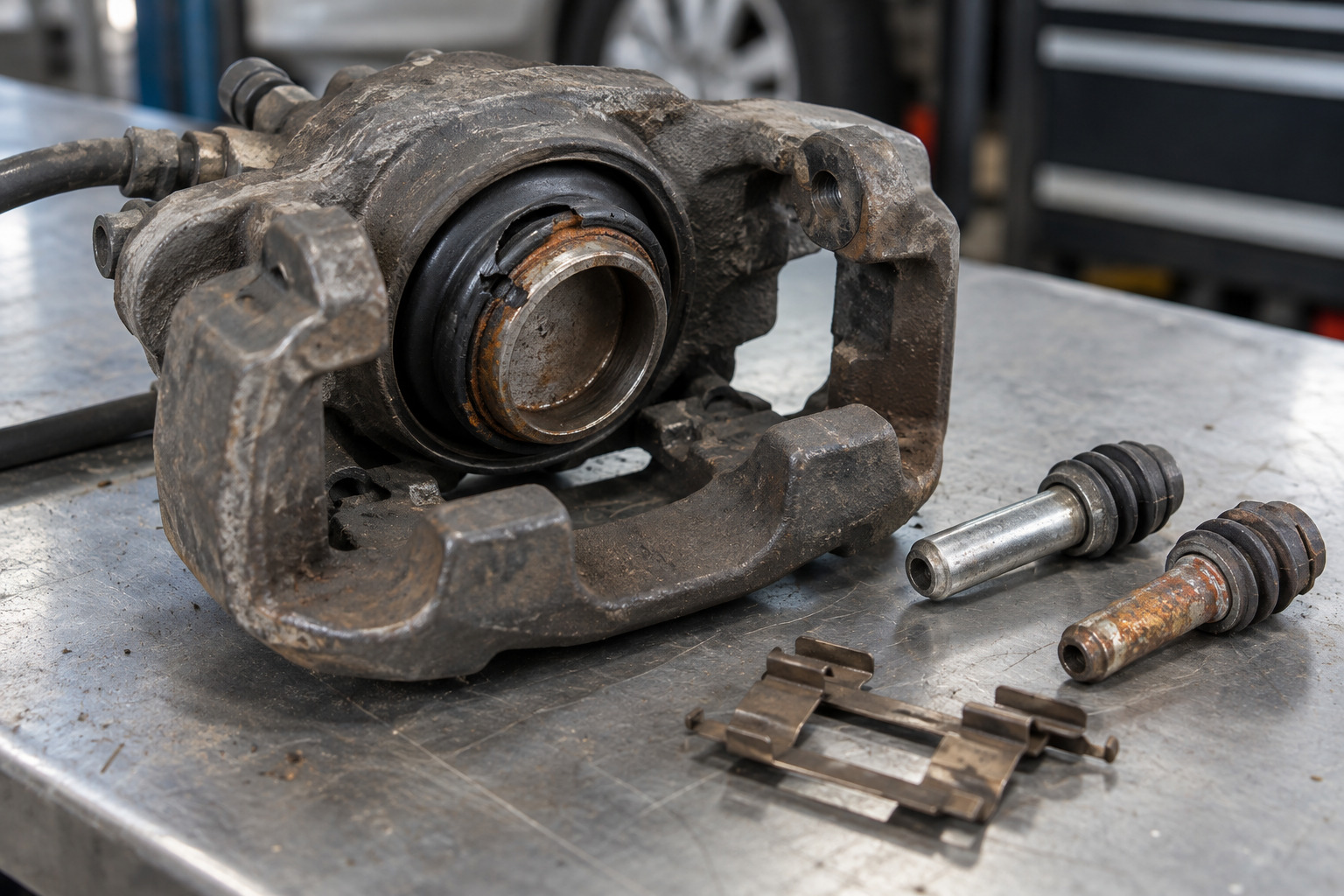
Five faults account for most caliper complaints, and each pushes the job to a different route.
Before any of that, rule out the hardware. When a pad binds or fails to retract, it often comes back to a worn or missing clip rather than a caliper fault at all. The hardware carries the pad and lets it move, and it is the cheapest fix on the list.
- Piston corrosion and pitting. Moisture that gets past the boot attacks the piston face, and a pitted piston drags in the bore and chews the new seal. Pistons are replaceable, so this alone does not end a rebuild.
- Bore corrosion. The same moisture works on the bore wall. Light staining cleans up. Pitting does not, and where it sits decides the job.
- A torn dust boot. The boot keeps water and grit off the piston and the bore. Once it splits, what happens underneath is a matter of time. Caught early, it is a seal kit rather than a caliper.
- Seized slide pins and bushes. A sliding caliper has to move on its pins. Grit and rust lock them up, so the inner pad wears hard and the outer barely touches. Fleet and work vehicles out of Melbourne’s northern industrial estates show this first. Short heavily loaded runs drive grit and salt into the pins long before the pistons wear. Pins rusted in place can often be cleaned up and put back, so look at them before pricing anything else.
- A seized handbrake mechanism. On a rear caliper with a cable handbrake, the lever and screw inside the piston can seize while the hydraulic side is sound. Check it separately; it changes the job.
The cheapest outcome on a binding brake is often not a caliper at all.
When can a caliper be rebuilt?
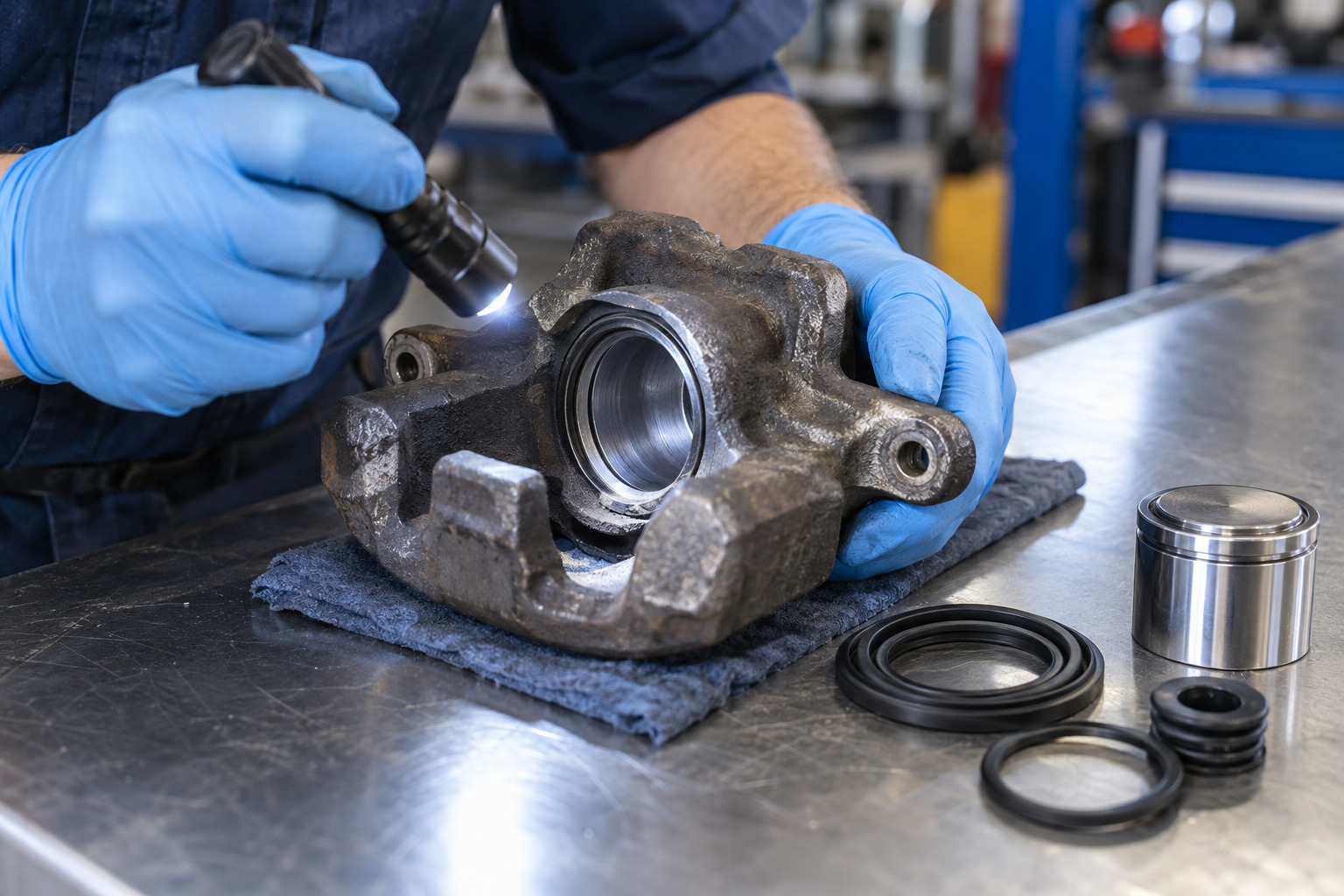
A rebuild keeps the original casting and replaces what wears inside it. The unit is stripped, the seals, boots and wear items replaced, and the critical surfaces machined and restored. Then it is pressure tested before it goes back on a car.
The gate is the bore, and it is pass or fail rather than a matter of degree.
A serviceable bore has a clean, unbroken surface where the square-cut seal sits. Light staining and fine corrosion hone out. Pitting does not. A hone takes off a thin, even layer; it cannot fill a pit. Where the pitting is in the seal land, the seal has nothing continuous to work against, so the unit weeps or drags. Scoring in the seal groove fails it for the same reason.
Corroded bores are sometimes sleeved back to size in stainless, but that is a remanufacturing job on classic and low-volume castings, not a bench fix.
The bore decides which routes are open before the budget does.
When is a reconditioned exchange caliper the right call?
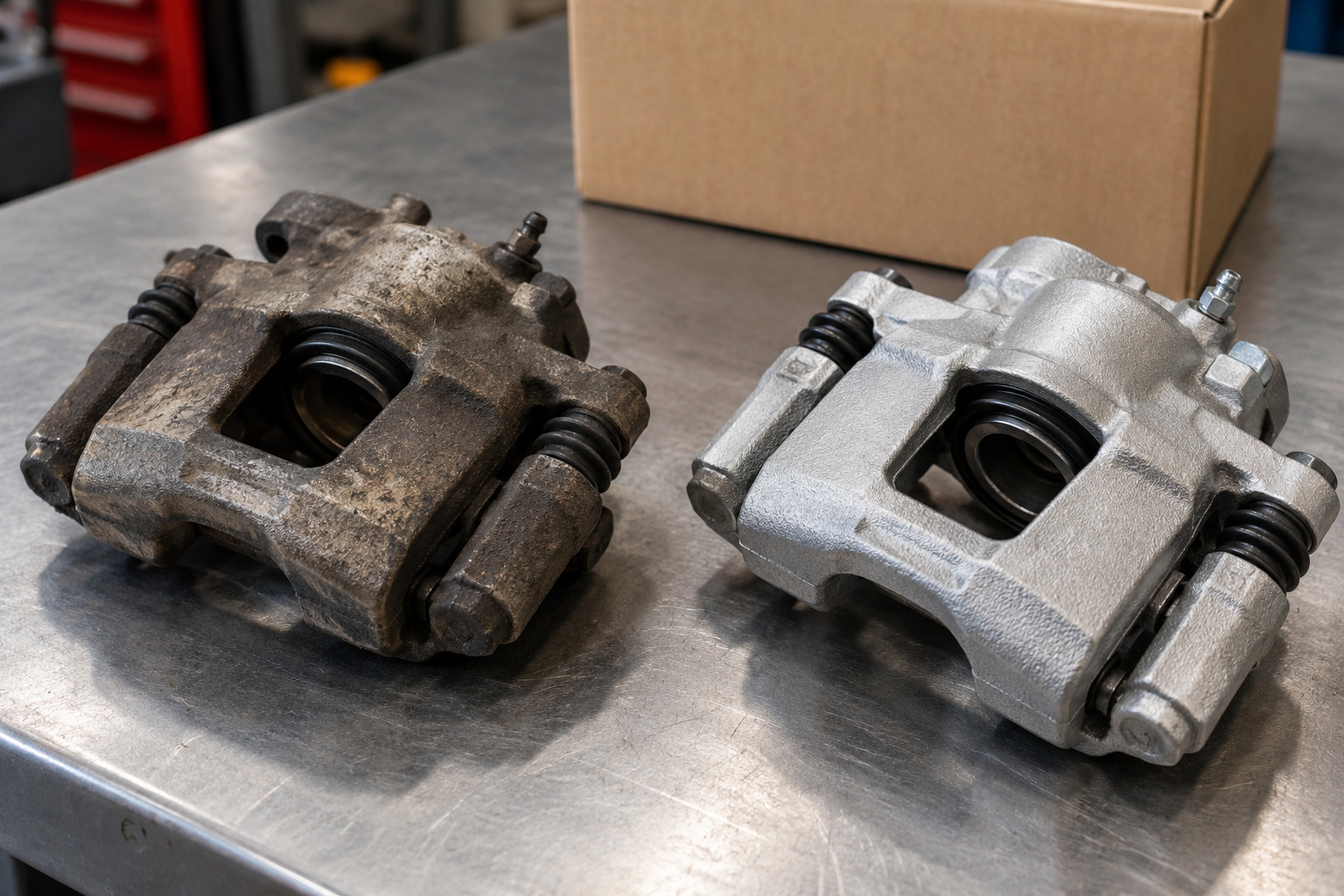
A caliper change-over works the same way as a change-over brake booster. The old unit goes back and a rebuilt one comes over the counter in its place. The bench work is already done, so it buys a part rather than a day on the hoist.
The old caliper is not scrap in that arrangement. It is the core, and it goes back to be rebuilt for the next job. The core charge is a deposit held against it coming back.
The honest limit on this route is availability. A change-over depends on a rebuilt unit existing for that casting, and for some applications there is not one. The make and model does not settle that; the number on the casting does.
When does a caliper have to be new?
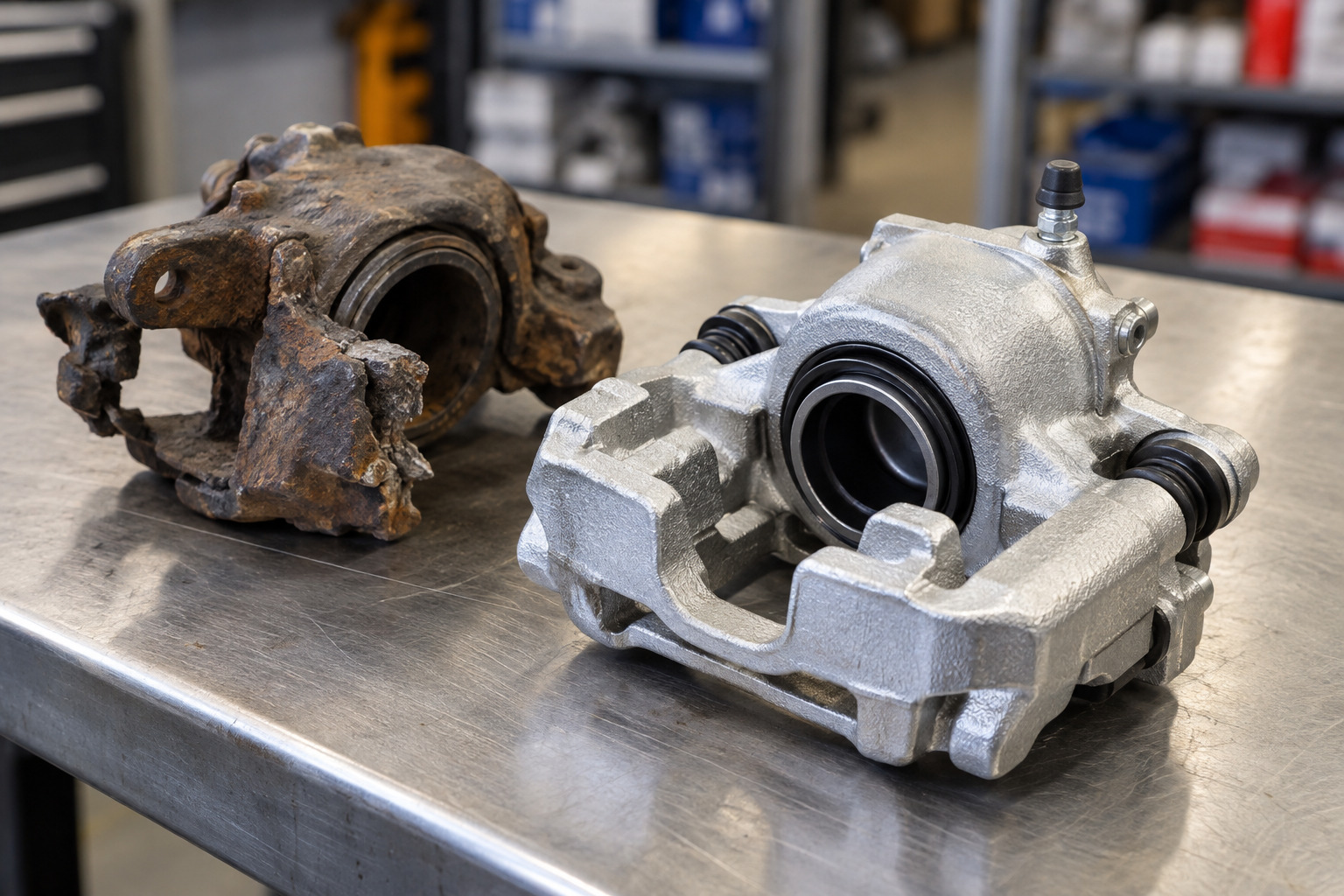
A caliper has to be new when the body is past saving, or when nothing exists to exchange it for.
- The casting is cracked or rusted through. Structural corrosion has never been a rebuild item.
- The mounting is damaged. Stripped threads, a damaged bracket or a bleeder snapped off in the body take the unit out of the rebuild queue.
- The bore is past cleaning. A failed bore ends the rebuild, so the choice narrows to a change-over unit or a new one.
- Nothing exists to exchange it for. Some castings have no reconditioned equivalent in circulation, which leaves new as the only route.
- Electric park brake calipers vary. The motor is usually a separate part from the body and often supplied on its own. The caliper has to be wound back with a scan tool before it comes off. Whether a rebuild or a change-over exists is a question about the casting, not about electric park brakes as a class.
| Route | What puts a job on it | What you give up |
|---|---|---|
| Rebuild the original caliper | The bore is clean in the seal land and the body is sound | The vehicle waits while the unit is on the bench |
| Change-over reconditioned unit | A rebuilt unit exists for that casting and the old one can go back | The original caliper, which has to be sound enough to rebuild |
| New caliper | The body is damaged, or nothing exists to exchange it for | The most money of the three, and often a wait on a part |
Why brake caliper replacement cost varies so much
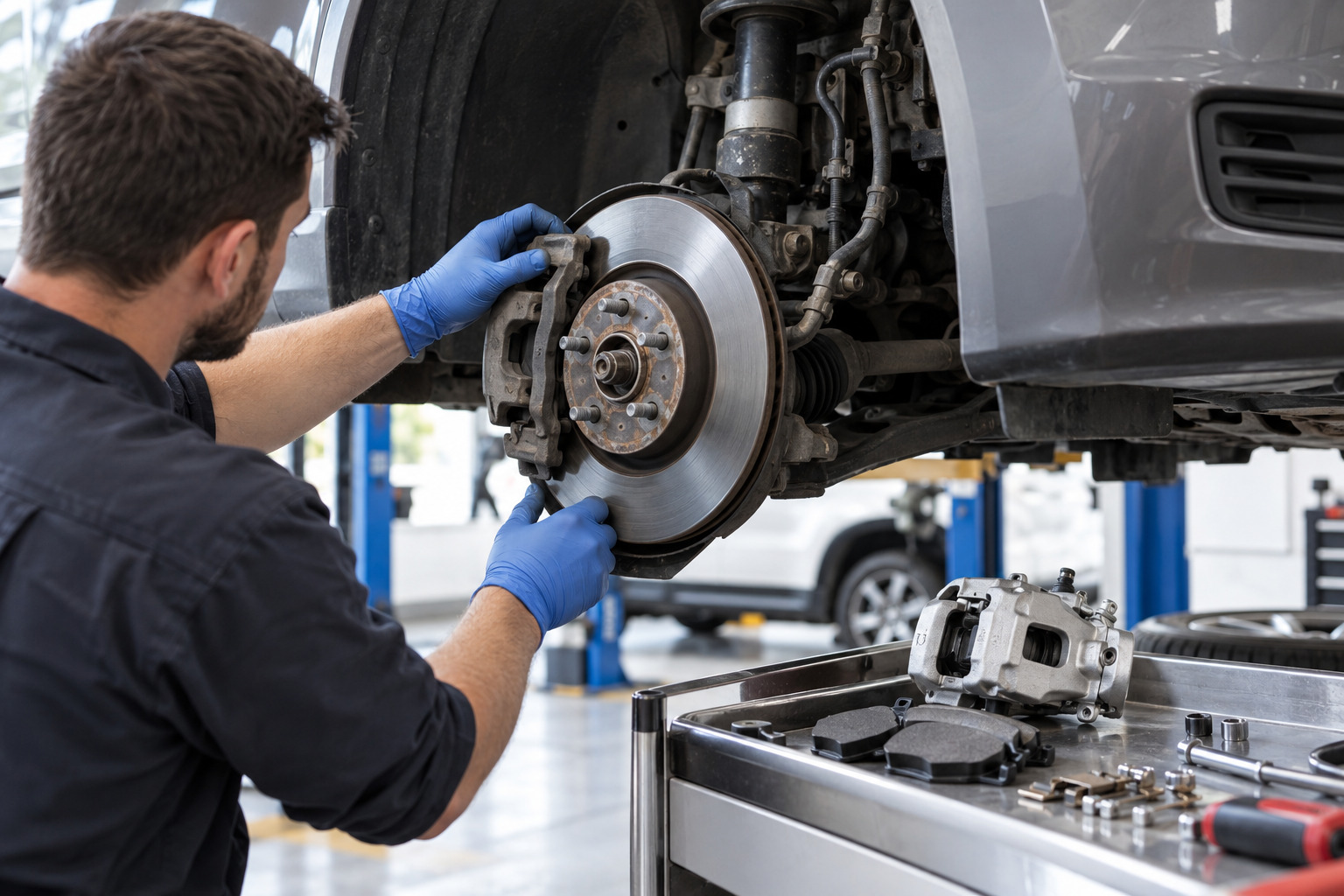
Two quotes on the same complaint can land a long way apart without either being wrong. Five things move the number, and each is about the scope of the job.
- One caliper or an axle pair. A single unit and a matched pair are different orders and different labour. A fresh caliper also releases more freely than the tired one beside it, and that difference shows up as uneven pad wear across the axle.
- Whether the hose and the hardware go with it. A flexible hose that has swollen internally holds pressure on the caliper and brings the new unit back with the same complaint. Hoses, hardware and the caliper are often ordered together.
- Whether pads and rotors are being done at the same time. The caliper is off the car either way, so the labour is small and the parts are not.
- How much of the system has to be bled. One circuit is quick. A system opened at the master cylinder, or one whose anti-lock module needs a scan tool, is not.
- Whether the unit has to be seen first. This is what stops a firm number over the phone. The counter quotes on the casting once the unit has been seen, because nobody knows the route until then.
Frequently asked questions
Do brake calipers have to be replaced in pairs?
Order both sides where you can, because two calipers of different ages stop releasing at the same rate. Where no change-over pair exists, fitting one unit and rebuilding its partner gets you to the same place. Fitting one against a caliper that is already dragging is the version that comes back.
What is a core charge?
It is a deposit added to a reconditioned unit and refunded when the old part comes back. The old part has value to the rebuilder, because it becomes the next unit on the bench. A body corroded past rebuilding may not earn it back.
Can a seized caliper be freed off rather than replaced?
Sometimes, and it depends on what has seized. Rusted slide pins can be cleaned up and put back, and that is a proper repair. A piston seized into a corroded bore is different, because freeing it does nothing for the surface the seal works against.
Why can’t a caliper be quoted over the phone?
The price follows the route, and the route is not visible from a description of the vehicle. Two of the same model can need different work, depending on the state of the bore. The casting number narrows what is available, and the strip settles the rest.
Have the casting number in front of you when you ring. It is stamped or cast into the body, and it settles whether a change-over unit exists before anyone prices the job. Better still, look at the bore and the pins first, so the counter is pricing a known job rather than a description. Brake & Clutch Warehouse rebuild calipers in-house at Thomastown and supply reconditioned and new calipers over the counter.